Well, here we are.
The land is acrid and dry. It’s gravely unsuited to agriculture, and barely enough to sustain a population. Yet, from these harsh lands, for a period in time, birthed the most terrifying military might that ever stomped the earth. Ancient empires fell before the Mongol hordes, and to think that they had started from these unforgiving swathes of grassland.


Inner Mongolia has modernised itself considerably since the days of Genghis Khan. There still are roving bands of nomads in the outskirts leading the traditional goat-herding lives, but these people are a distant minority. Across the centuries, the Mongolians have settled down, built cities and engaged in commerce like the rest of us.
On our way to Hohhot, the capital of Inner Mongolia, we spent one night in the grasslands of 黄花沟草原旅游区 (Huang Hua Gou Grassland Tourism Area). I was expecting a rough-ish stay in our yurts here, but it turned out rather comfy. It’s the equivalent of glamping, to be honest. The entire area was a bit like a resort, with a central building filled with shops, food stalls and restaurants. Each yurt comes with electricity and air-conditioning, an en-suite stocked with fluffy white towels, and two large queen beds.


I’m glad we got the non-traditional version! Would anyone these days prefer to stay in a “traditional” yurt? “A bed of manure” turned out to be quite the literal saying in the olden days, and not just for gardening. The ancient Mongolians would spread a layer of manure against the cold grassland as insulation, then drape the manure with layers of leather to complete their bed. I imagine it'll smell pretty gamey, and with a cooking fire, the entire yurt would probably be filled with smoke.

Within our first hour in Inner Mongolia, we saw a rare sight: rain. On the steppe where rain comes perhaps once every 30 days, it rained constantly on the day that we arrived. We paid a visit to a local establishment, and a guide demonstrated how their milk tea, Suutei Tsai, is traditionally prepared. We watched him combine black tea, cow milk, and a local version of butter in a wok placed over charcoal.


Suutei Tsai is salty! It's a savoury drink typically drank at breakfast, and people would sometimes add millet or barley, or roasted goat meat, to the milk tea to fortify themselves for the day ahead.


The first cup is given to the land and sky as an offering. His movements were mesmerising in the rain.


The first cup is given to the land and sky as an offering. His movements were mesmerising in the rain.

We were served aaruul with our suutei tsai, a variety of traditional dried milk biscuits and milk curds.
Mongolian cuisine heavily features milk products, and is perhaps the only Asian culture that does so to this extent. Tsagaan Idee, or “white food”, are Mongolian dairy products, which are traditionally eaten during the summer months. There’s Suutei Tsai, their milk tea, of course, and Aaruul. There’s Tarag, yogurt which are made from the milk of sheep, goat, cow or yak. There’s Airag, or fermented mare’s milk - this one was pretty interesting; it tasted quite smooth, and quite similar to Bailey’s. There’s also a version made with fermented camel’s milk (Hoormog), which I couldn’t find, but I didn’t try all that hard.
Mongolian cuisine heavily features milk products, and is perhaps the only Asian culture that does so to this extent. Tsagaan Idee, or “white food”, are Mongolian dairy products, which are traditionally eaten during the summer months. There’s Suutei Tsai, their milk tea, of course, and Aaruul. There’s Tarag, yogurt which are made from the milk of sheep, goat, cow or yak. There’s Airag, or fermented mare’s milk - this one was pretty interesting; it tasted quite smooth, and quite similar to Bailey’s. There’s also a version made with fermented camel’s milk (Hoormog), which I couldn’t find, but I didn’t try all that hard.
 |
| A delicious pint of yogurt while we stroll around the grassland |
In the winter, “Red foods” - the meats - predominate in their diet. Lambs, goats and cows are traditionally roasted whole, and diners would approach the roasted meat and carve out a portion with their side knife. Nobody carries a side knife anymore these days, as we were informed, and animals are rarely cooked whole. Such is the price of civilisation. The mutton dishes weren’t too gamey, and the best dish I’ve had in Inner Mongolia was their lamb skewers, liberally sprinkled with chilli powder.

On our second day in the grasslands, as the skies cleared up, we rode placid mares through the nearby grasslands, and walked through the gorgeous gorges of 黄花沟地质公园.


It’s not the unfettered views of nature that I’ve expected. Here and there, the windmills dotting the landscape are hard to avoid. Aside from being a bit of an eyesore, windmills also discourage birds from nesting in the area, leading to proliferating rat population and upsetting the biodiversity. It’s a reminder that not all green energy are equally good for the environment. Solar energy is perhaps more suited for the ecosystem. I’ve read online that this grassland was developed to harness wind energy, so perhaps the other grasslands in the area wouldn’t have these windmills.

We ate in the resort’s restaurants. One of them is 诈马宴 (Za Ma Yan), a themed dinner recreating a royal feast, with traditional songs and dances done over dinner. It looks a bit like the US’s Medieval Times restaurant. There’s also an amphitheatre where shows are run regularly, including acrobats and stuntmen on horses. The entertainment can be a bit of a mixed bag (I wouldn't go back to the themed dinner, for one). But across the two days, some of the acrobatic performances were truly spectacular.

97 Mongolian Ranch is a shop here that’s pretty great. Their Roasted Grain Milk Tea (炒米奶茶) has more of the roasted millets and that slightly salty taste that I’ve come used to. And their drinking yogurt was pretty fabulous too - thick, rich and lightly sweetened. I couldn’t resist buying their liquor. The ones made from cow’s milk are a clear liquor, though the one of horse’s milk retains a chalky appearance. I carted the liquor back to Singapore, where I opened the bottles and ... one sip's more than plenty, thank you. In his own way, the store assistant did sorta warned me about them, but I only heard what I wanted to hear. They make for good souvenirs, and perhaps for a neat party dare.

While in Hohhot, we visited Dazhao Temple and Sai Shang Old Street. We were recommended this ice cream stick from Cao Yuan Nai Gao. It’s an old-school type of ice cream, with roughly-hewed sides. It’s fluffy and aerated, with a prominent milk taste. I like it. There is also a green bean flavoured version that is rather strong-tasting.
 |
| Caption: don’t let the horse logo scare you off! It’s made from cow milk. |

And in the vicinity, while snacking on winter dates and mandarin oranges that we bought from a roadside stall, we visited 美岱召 (meǐ daì zhāo), a Tibetan Buddhist temple located along the outskirts of Baotou.

A modern experience in Hohhot is Yili Milk Factory, a local powerhouse in milk production. I was expecting a taste-forward experience, but funny as it sounds, taste is secondary in this milk factory tour. The tour had more emphasis on their feats of engineering. We walked through the production line for their products like UHT milk and milk powder. It’s interesting from a technical engineering standpoint from its manless forklifts to near-manless assembly lines. But the actual products were a let down. I tried the milk and the ice cream. They're alright. Producing such high volumes of milk which likely meant blending milk from many herds to form a consistent product, dulling the tastes. And the UHT treatment wouldn’t have helped.
 |
| Winner winner, milk carton dinner |
This tour is clearly a technological prowess display first and foremost. Even their restrooms have a (?)helpful display outside for toilets are in use. Watch as a person enters the restroom, and look at the green icon turn red as he goes into a cubicle. Who wouldn't want everybody else to know exactly which urinal you used?
 |
| Did you wash your hands? We’re watching (and judging) you :) |

While in Hohhot, we also visited 哈素海, a lake on the outskirts of Hohhot just in the shadows of the Yin Mountains. It’s a little like Ninh Binh, but I far prefer the little rowboats of Vietnam than yet another of these motorised Chinese sightseeing boats that have been decorated to look like palaces.
We next went to Ordos, Inner Mongolia’s cultural centre. The new district Kang Bashi is the seat of the local government. The district had been built to accommodate 6 million, but so far, only about 600 000 people reside here. Even the city centre is empty! We had a serene walk through the Ordos Wedding Cultural Park and the city centre.

We next went to Ordos, Inner Mongolia’s cultural centre. The new district Kang Bashi is the seat of the local government. The district had been built to accommodate 6 million, but so far, only about 600 000 people reside here. Even the city centre is empty! We had a serene walk through the Ordos Wedding Cultural Park and the city centre.
 |
| Mausoleum of Genghis Khan |

At the end of the tour of Mausoleum of Genghis Khan, I picked up more yogurt and ice cream.
 |
| Okay I’m a sucker. After listening to the guide talk about the cows of Mongolia daily, I realised I’ve been buying yogurts and ice cream everyday. |
 |
| I visited a supermarket to buy a carton of fresh milk. Again, it’s alright. Though the yogurts of Inner Mongolia are rich, creamy and very very good. |

As Orbos borders the East Kubuqi Desert, we took a day trip to the desert to 响沙湾 (Xiang Sha Wan, Whistling Dune Bay Resort). We rode on a camel and climbed sand dunes. Some parts of the dunes are even teeming with greenery.

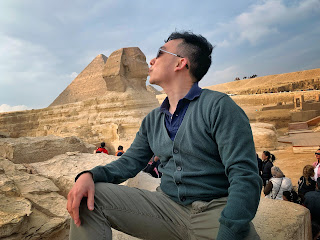
It’s an alright experience too, though a far cry from Egypt. There’s “touristy”, like riding a camel in front of the pyramids, and then there’s “touristy” like building a resort in a desert to invite tourists to ride camels around a compound.


What’s this? I gotta say, I wasn’t expecting a water park in the desert, or a swimming pool surrounded by sand dunes, but there ya go. As the guide later explained near the end of our trip, Outer Mongolia is a landlocked country and bodies of water are a major attraction for tourists from these areas.

We also watched a play on an Ordos wedding. It’s more interesting than it sounds: one part involved the dancers moving in synchrony while balancing a bowl of water on their heads.
The week that we spent in Inner Mongolia had been interesting. We visited a lot of old towns and rural areas, but in the more modern areas, like the mall that we visited one night, would not have looked one bit out of place in Singapore or in New York. On our way back to Beijing, we stopped at Datong 大同市, the closest Chinese city to Inner Mongolia. It’s a peripheral city, but the technology is still staggering. In the city, the Chinese GPS app on the driver's phone doesn’t just give directions and warn of red light cameras; it also tells you exactly how many seconds before the traffic lights at each intersection change.

One place we visited in the Datong region was Yungang Grottoes, a complex of shrines and Buddha statues. We were warned that this place is very popular and full of tourists, though we lucked out: it was serenity when we visited.


This place has Egypt vibes. The statues and rooms were carved into the rocks from over 1500 years ago. There’s a fair bit remaining, though like Egypt, some parts of the sites has been degraded by time and nature and a fair bit of banditry.

Here and there along our journey, along little streets, I spotted some traditional snacks that I’d had in my childhood but not seen since. There are hard caramel candy, shaped into animals and dragons. There’s hand-pounded peanut candies too, both of which are like little remnants of history from a rapidly advancing country.

We went to Datong Old Town both in daylight as well as at night.


In the daytime, it’s a tourist spot with architectural relics from the Ming dynasty. We walked around the area in the morning, and had lunch at 喜晋道面馆. It was the best meal we had on our entire trip. The restaurant had been mentioned on the Chinese social media platform 小红书 xiaohongshu, so I had been keeping a look out for it. But I was clued in to its location by the huge amount of people outside the storefront sitting on chairs and waiting for a table. Their specialty is the 刀削面, noodles made by shaving strips off a large piece of dough directly into boiling water with a curved blade. The noodles at this shop is more pleasant than any others that I’ve had: each strand is chewier and thicker. The meat pieces are tender and flavourful. And don't miss out on their skewers - both their lamb and beef skewers are equally fantastic.


Datong belongs to a larger province named Shanxi 山西, which is renowned for their vinegar. I've had some vinegar ice cream. It's not as strange as it sounds; after all, aged balsamic vinegar can be drizzled over ice cream.


We returned to this area in the evening, which is quite a different experience than in daytime. There are less tourists for one, and many more locals. Many food stores are only open from evening onwards, selling food and drinks, and live music pours out of the bars. We walked around after dinner and ate perfectly cooked roasted drumsticks from a store named 茶熏鸡腿 (the queue in front of the store clued me in that I should definitely buy their drumsticks), and slurped down milk tea as we walked down the roads. We walked past 東空間, and the jazz song from beyond the doorway made us stop in our tracks. We stepped in. Tables and chairs are set up along the alleyway, and we took a corner table facing the singer. She’s good. Very good. The bar where we order drinks is just behind a glass panelled door, a sliver of space for a countertop and bar stools. And there you have the bartender. There’s those boisterous kind of bartenders, like the ones we met in PS150. Then on the other end of the spectrum, there’s her.
 |
| She's cool as a cat. |


And as the singer finished her set, and as we finished our drinks and the bar started to wind down, we left the area, our perfect night in Datong.