Chik's Crib

15 June 2025

Osaka City: Osaka in Spring (Part 1)

June 15, 2025 0
Osaka City: Osaka in Spring (Part 1)

We landed in Osaka half an hour earlier than scheduled (planes can do that? Go Scoot!). We had booked our airport transfer railway tickets for a later timing, but it was no biggie to reschedule our railway tickets for an earlier timing on our phones. I didn’t know about this tidbit when we came to Osaka, but apparently, in the last thirty years, Kansai Airport has not misplaced a single luggage. And that’s not all that is amazing here. After we passed customs and reached the Baggage Collection area, we saw that the checked-in luggage had been taken off the conveyor belt and placed in neat rows by the side for the owners to wheel away (!) I was pretty gobsmacked. Not only do passengers not have to wait for their luggage, the luggage have also all been taken off the belt for us? In no time at all, we were out of the airport and on our way. 


We were staying in Shinsekai for a night, and the first order of the day was to find food. A queue was already forming by 5pm in front of Kushikatsu Daruma, and so we quickly joined it. This small shop is the originator of Kushikatsu, the regional specialty of deep fried skewers. It’s a small restaurant, with about 10 countertop seats available. The customers were fully locals, but there was an English menu, and armed with the phrase “o-susume onegaishimasu” (recommendations please), the restaurant staff and I made the dining situation work. I might have used it a bit too liberally though: at one point, he asked me if I wanted a beer, and while in front of the fridge overlooking the bottles of Asahi beer, I still replied with “o-susume onegaishimasu”. I think he laughed at me.


We started off with doteyaki, a traditional Osakan specialty of beef tendon stew with chewy rice cake cubes.


It was an excellent restaurant: he pointed to each skewer as he served them, and explained which was which. The skewers were wonderfully battered and fried with a very clean taste, there was no excessive oily texture or taste. From meat to vegetables to juicy mushrooms, there were no faults. After a fellow customer bit into his skewer and pulled away with a thick stretch of cheese between his skewer and his mouth, we quickly ordered what he had. The deep fried Camembert and mozzarella skewers were outstanding.


There were plenty of street food in Shinsekai, and we walked around the area and soaked up its iconic retro vibe. I bought the local favourite Okonomiyaki, a filling savory pancake dish cooked on a griddle. This Okonomiyaki from a busy corner store turned out to be a really really good version out of out of all those we’ve had.


it didn’t look the best, though. Perhaps it wasn’t meant to be carried sideways? Also, Strong Zero isn't half of what reddit raved about. It’s a one-dimensional cheap lemonade fortified with booze. There are much better drinks out there.


We left Osaka for a bit to tour Kyoto and the surrounding Alpine towns (more on that in a bit!), but we returned to Osaka for the last leg of our holiday. We were planning to explore the cultural side of Osaka, but life in a busy city has a way of filling up our days. There are markets to explore, restaurants to eat and shopping to be done.


Everyone visiting Japan should try Cremia Ice Cream at least once (can be found in many different restaurants.) The cone is a thin rich crisp made from langue de chat, and it tastes like an ice cream version of Shiroi Koibito


Strawberries are still in season, and we finally tried some of the fancier white Japanese strawberries. We ate strawberries for breakfast almost every day . 


While not strictly a tourist attraction, I spent a lot of time salivating over the kitchenware at Sennichimae Doguyasuji Shopping Street. Who doesn’t need more cookware in their lives? We bought chopsticks, alongside a bamboo matcha scoop and glazed matcha bowls. I picked up a pair of kitchen shears from Tojiro, and then spent another hour sighing over their knives. I also tried to find a Kamado-san, or Japanese clay pots, which I’ve heard are quite reasonably priced in Japan and outrageously expensive elsewhere. In the end though, I passed on it because my luggage were already full with sake bottles. Maybe next trip.

Our days in Osaka passed pleasantly. There’s no shortages of things in Osaka to sing praises of (for example wet serviette that came with every meal, even from 7-11), but the most memorable aspect was the bar scene. The bespoke bars blew me away with their cocktails.


Our first bespoke bar experience was at
Whisky&Cocktail BAR SIMON 大阪道頓堀, which was hidden behind an unassuming plain wooden door on the second floor of a small building. It’s a small bar, fitting no more than 10 patrons. The place was empty as we walked in after an early 5pm dinner, but it filled up by 8pm. The crowd was well-deserved. 


Bespoke bars have no menu. You instead tell the bartender what you like and he’ll make a drink that fits. The four of us told him what we were each looking for, and we watched him build four drinks concurrently to serve us at the same time. Near the end, he returned with several chunks of ice and proceeded to hand carve each ice into different shapes to fit each drinking vessel.


He tasted each drink as he made it, which was a step that I’d not seen before. My first drink (I asked for something fruity and floral) was good. My second (to make a cocktail with Kinamori Gin, a Japanese gin that I had been trying to find a bottle of to no avail so far) was on point: the gin shone in a sweet cocktail with chartreuse that highlighted the gin’s woody notes.


Because there was no menu, we didn’t know how much the drinks cost. But as we were sipping on our first, then second, drinks, I found that I didn’t much care about the cost, I just want to see what else he’s got.


A request for a “cocktail that tastes like tea” gave him pause. He took the bottle of chartreuse that he used for my Kinamori cocktail, sniffed at it, frowned, sat it back down and reached for another chartreuse. (We learnt later that the second bottle, a limited edition bottle, had a different flavour profile). There was Ki No Bi gin, chartreuse, coconut water and green tea liqueur. The end result was a deliciously clear green-coloured cocktail, and tea-forward as promised.

I enjoy baking and cooking, but even as finicky as baking can be, at least all the ingredients are pretty much interchangeable from brand to brand. Can you imagine trying to bake if one AP flour tastes dramatically different from another brand of AP flour? Crafting cocktails off-the-cuff just like this is simply on another tier of skill. As we each finished our second drinks and as the small room gradually filled up with customers who started smoking, we settled our bill: the drinks cost about 1700 yen on average, and there’s no cover charge. Incredible.


Another bespoke bar is Bar Nayuta. I’m spoiled by this no-menu customs, because my pet peeve is trying to read a menu in a dark environment. Non-smokers would be happy to know that Bar Nayuta is strictly non-smoking, which is pretty rare amongst the bars here (We visited Bar Shiki and Bible Club a couple of days ago, and our experiences at both of the bars were spoilt by a single smoking customer. Cigarettes are period-accurate for The Bible Club’s atmosphere yes, but all that second-hand smoke isn’t enjoyable.)


We put in our usual requests: a tea-forward cocktail, a floral sakura one and a woodsy cocktail. They were all good. The magic came at our fourth request, when we asked for a cocktail “that tastes like popcorn”. (The context was that the Bible Club’s menu had a popcorn cocktail made with popcorn-flavoured vodka which my wife liked. We wanted to see what Bar Nayuta could do with this curveball order.) The barhelp commented that it was a hard order with a rueful smile, and after clarifying that we didn’t mean something with a yuzu corn profile (I don’t know what that is, but now I’m interested), passed the order to a first bartender. We could see him mouth POP-CORN? from across the bar. The order was then handed over to the head bartender. A few minutes later, we thought could smell caramel popcorn from the countertop, though from what possible ingredients, I could not tell for my life. He definitely wasn’t melting sugar for one. To the caramel-like concoction in the cocktail shaker, he added shochu, egg yolk and cream. As a finishing touch, he sprinkled sugar and used the blow torch for what looked like ages to get a crème-brûlée-like topping over the drink. It’s not a large bar, and the seats were facing the bartenders. All conversation at the bar stopped as everybody turned to watch him handle the order.


The drink wasn’t just a spectacle. It was spectacular. What came out on the other end was truly amazing, and surpassed anything I could have dreamt of. The drink itself was thick, creamy and sweet,  like an eggnog with tones of caramel. The edge of the glassware was rimmed with salty and hence tasted both sweet and salty, just like a sweet and salty popcorn mix. 


We loved the bar culture so much, we went to 1-2 different bars every night, usually with dinner before and supper afterwards. I thought that the restaurants in Dotonbori and Shinsekai (the main tourist districts) would open til late and would be perfect for bar crawls, but as it turned out, most shops are shuttered by 9. (What’s up with this? Osaka is a metropolis and Dotonbori in particular is meant to be The Place for Nightlife). but luckily we found a few places that are opened til late for supper.


We had a good supper in Shinsekai Kushikasu Ittoku Hozenji, a kushikage in Dotonbori open til midnight. The skewers are freshly fried, and a perfect follow up to cocktails. 


Mambou (Mambo on Google Map) makes good okonomiyaki, they’re run by a cute elderly couple and their son, and also, they are open until 1am. 


Ten Ti Jin has a few branches around Osaka, They’re open until 3am. The service can be a little gruff, but the charcoal-grilled pork bowl (butadon) is a work of art. 


Aside from my gripe about how early restaurants close, there are many good restaurants all over Osaka, and available at every price point. Rather than trying to tick particular restaurants off a checklist, we’ve learnt instead to choose our restaurants by their locations and their opening hours. There were also lunchtime specials from many restaurants.


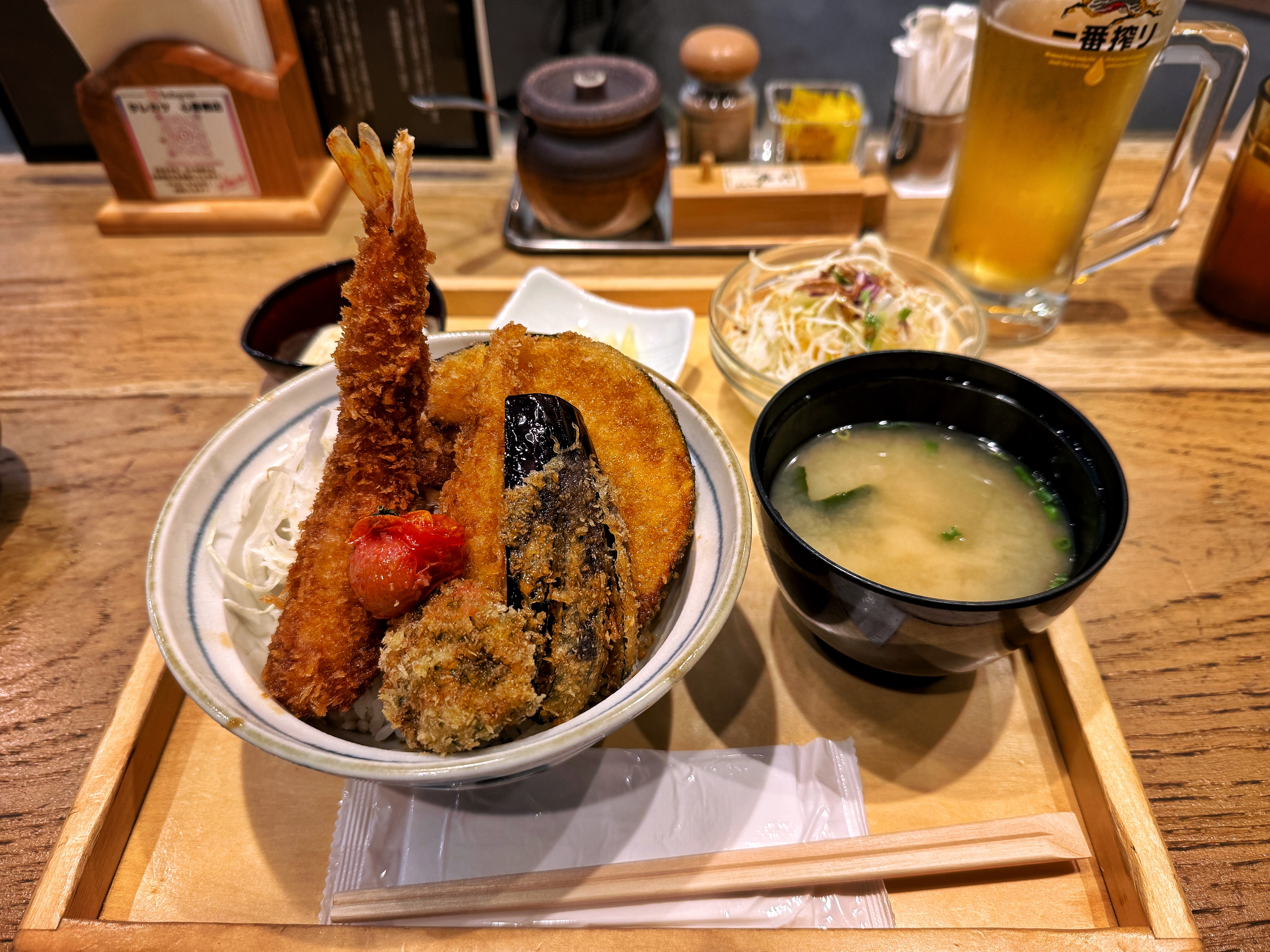
We had the lunch set at Tempura Daikichi Namba Komejirushi near our hotel, which goes for 900 yen per pax. You get a full meal of rice, a set of tempura, and clam soup. We’re particularly fond of Set D (The Lady Set), which comes with tempura fish roe, and a skewer of fried cheese and cherry tomato.


One of the ?perks of the restaurant is that customers get to throw clam shells from  the soup onto the floor. The floor is full of broken clam shells, and you can add yours to the pile, if you like. Though I think woe betides you if your clam shells fall into another table's bag basket (which is also on the floor). 


Gokai Tachizushi Nambanankaidori, for example, is a sushi place with pretty good service. They also seem quite flexible as to what constitutes lunchtime. We visited close to 5pm but still somehow qualified for their lunch offer. Our bowl of rice came with a mountain of uni and roe (it’s as generously filled as it was pictured), with a side of those firefly squid from Toyama.


And look at the size of each unagi sushi!


Niigata Katsudon Tarekatsu Shinsaibashiten was another good find with a lunch promotion. The pork fillet is pounded into thinly before being breaded and deep fried, and the rest of the tempura were all well fried. I think I ate more fried food on this trip than the entirety of last year.

Chibo Okonomiyaki is a curious restaurant. It’s run like an Emergency Department and I was getting flashbacks. The cooks are constantly cooking several okonomiyaki in front of them. When their shift is up, they just hand-over to the next person coming on for the next shift to continue the cook. There’s a hierarchy in the staffing, and there was clear deference being shown from some cooks to other cooks. The service was great, and there’s a good deal of showmanship, but there are better okonomiyaki around. 


One surprise for Osaka: it’s called the food capital of Japan, but I think a more accurate term would be the street food capital of Japan. There's loads of restaurants serving okonomiyaki and takoyaki clustered in Dotonbori, but so many of the popular restaurants all also serve these street-style food. I have a few quibbles with the Osaka branding. Still, Osaka's a nice place and I'll happily spend a few days there anytime. 

Just make sure you have your dinners early.


Note the deserted streets and shuttered storefront in Shinsekai. The sun's not even set yet!  

Recent Japan Travels:

Osaka in Spring 2025: Osaka City (Part 1)

Osaka in Spring 2025Kyoto and Uji (Part 2)

Osaka in Spring 2025Hida-Takayama and Shirakawa-Go (Part 3)

Osaka in Spring 2025Toyama and the Alpine Trail (Part 4)

Osaka in Spring 2025: Matsumoto, Nagano: (Part 5)


13 May 2025

My First Sake Tasting at Inter Rice Asia’s Anniversary Warehouse Sale

May 13, 2025 0
My First Sake Tasting at Inter Rice Asia’s Anniversary Warehouse Sale


The first time I’ve heard of Inter Rice Asia, it was from a colleague. Her family owns a Japanese restaurant and gets their bottles from this sake supplier, who regularly goes to their restaurant to hold private tastings for their new products. (Lucky her!)


When your family is in the restaurant business, you learn to take booze seriously and treat each bottle with care. Proper alcohol storage with climate control is essential to keep them in an optimal condition. I’m a bit more casual, and may have given her a shock when I briefly mentioned that I’m storing my wines in my wife’s old dormitory mini-fridge instead of getting a wine cellar. Fridges apparently run too cold, and the condensation that results when taking the wine bottles out of the fridge can damage the labels. (Who knew? Definitely not the guy who’s calling them booze. Though in hindsight, if you look at the picture, you can see the one of the labels have indeed soaked through from the condensation.)


I’ll pass on ordering a wine cellar for the time being; the bottles that I’ve been buying are probably not in the same stratosphere as the ones that she’s getting, and my customers (i.e. me) aren’t as persnickety as the people that she’s used to dealing with. While I don’t think my laissez-faire ways will win me an invitation to any of Inter Rice Asia’s private tastings anytime soon, luckily for me, the sake importer held a public tasting event for their 17th anniversary. So off I went.


It was held on the third floor in a quiet industrial park in Kallang, and off every beaten track. It’s not the easiest location to get to, and you wouldn’t want to be driving to attend an event like this. But on the bright side, there’s a nearby eatery serving terribly good steamboat, and I recommend getting lunch first before you start drinking.


There were eight tasting booths, and many, many sake bottles for sampling. I’ve been to similar events for wine tastings, and I also attended a couple of whisky exhibitions, so it was a particularly pleasant surprise find that the sake dealers and lovers are so chilled out. Wines (and sometimes whiskies) can invoke a certain vibe in the servers and their clientele. IYKYK. At the sake tasting, everybody just seemed so warm. From the servers to my fellow patrons, everybody were friendly and approachable. I made a remark on how little I knew about sake, and just about everybody’s eyes - from the servers to the patrons - simply lit up. The servers started talking about the sakes they were carrying, explained their favourite bottles and guided me towards what they enjoyed. Even the other patrons spoke about what bottles they enjoyed and guided me to several fascinating choices that I might not otherwise tried. This conversation starter might have gotten me shunned at a wine tasting, but folks here were excited about sake and weren’t afraid to be warm and show it.


While we were taking a break from all the sakes that we had drunk, we struck up a conversation with another patron who turned out to be a sake educator. She pointed us towards her - and soon to be ours - favourite buy: a sweet sake liqueur made with mikan, or Japanese mandarin orange. This was one of her top choice to make sake cocktails with, and she had put down an order for 3 bottles. It was just about the end of the event, but the servers were such sweethearts and continued pouring for us. The sake was sweet and tart, almost as sweet as the servers. Truly, the mikan sake liqueur and its Yuzu cousin were terrific, and we added both to our growing basket of sakes. (If you see the first picture again with the almost-empty bottle, it was because it was so delicious, we near-finished our bottle before I thought I should take a photo of it.)


All too soon, the tasting session was over. As I joined the queue to pay, I made small talk with a well-dressed gentleman who soon introduced himself to be the owner. He peered into my basket of sakes and asked if I had the chance to try their warm sakes. I didn't have time to, but even though the tasting session was over, he invited me to go to the booth after I made our purchases to try those sakes. I was still reeling from all the alcohol that I had drunk, so I passed on the offer. But it was a business run with grace.


(As I was writing this post, I realised that I didn’t take any pictures at the actual event. I didn’t want to appear even more of a rube by whipping out my phone to take photos. So instead I’ll put a couple photos taken from my recent Takayama trip that I went on after this sake tasting event.)


A common refrain that I’ve heard about sake was that they often didn’t taste like much of anything, which was understandable as they're usually lighter compared to wines and spirits. There’s a grain of truth in that (pun intended): restrained, light-tasting and elegant sakes were often a deliberate stylistic choice. Breweries from Niigata in particular are renowned for creating such sakes, with their sake philosophy to avoid overshadowing the food that they are paired with.


When I was touring Hida-Takayama, a region famous for their high quality beef, I was at a local sake brewery. I asked one of the staff for a recommendation to pair with the beef that I was going to cook that night, and without a moment's hesitation, she directed me to a light-tasting sake, while explaining firmly that "if you want the Japanese way of food pairing, this is the sake for you." If you'd spent any amount of time travelling in Japan and interacting with the customer-facing staff, then you'll understand that her choice of words was as certain and forceful as she can get. Choose another style of sake and you'll be a fool, gaijin. That sake - which wasn't part of their most expensive lineup - wasn't the fruity sort of sake that I liked, and didn't stand out amongst the other sakes while I sampled one ochoko cup after another while earlier at the brewery. But later, as I drank it with our steak, I realised that she was right. Its restrained profile cleared my palate and the next bite of beef tasted as good as the first bite. A full-bodied fruity sake would have been far too heavy and contrasted too much with the rich beef.


As an aside, I was pretty really proud of this meal that we cooked. It was an impromptu decision to cook after we stopped by a supermarket near our apartment, and saw the quality of the beef! I grabbed several other ingredients - vegetables, shrooms and tofu - and anything else that I thought looked good. It was my first time working with kelp. We were in and out of the store in half an hour, and only took us 42 minutes from entering our apartment to finish plating our dinner. (Yes, I timed. I wanted to cook all that beautiful beef, but I didn't fly to Japan to play house for the whole day. Guy's got tourist attractions to visit.)


Of course, not all sake are created to fit a restrained style. There are many styles of sake out there. We’ve also had some incredibly bold, intensely floral and fruity sakes. These sakes are easy to enjoy, easy to drink, and perfect for beginners like myself. There were even heavy umami-driven aged sakes (koshu) that we tried from Inter Rice Asia's tasting, with funky tasting notes of mushrooms (we tasted chicken essence). These can be a bit of an acquired taste.

But every sake pairs well with a good snowy mountaintop view. (Photo from our trip in Toyama, in Midagahara Hotel up on the Japanese Alps)


I slant towards the bold fruity sorts. How wonderful is it that a drink made from rice can have such fruity and floral notes? I approach sake the way that I learnt to approach wine, and I wanted those intense, complex flavours and a long finish. If you're new to sake too and think that it sounds like something you'll enjoy, then you may want to seek out sakes that are “Nama” (meaning fresh and unpasteurised), “genshu” (undiluted), and “muroka” (non-charcoal filtered). These terms indicate certain brewing choices to deliver the maximum amount of flavours in each sip. These brewing methods usually go together (but not always!), and you may find it enjoyable to get those sakes, chill them, and sip on them cold.


Just don’t tell any alcohol connoisseurs if you’re planning to stick your bottles in your fridge.

30 March 2025

Bintan, Indonesia 2025: 2 Nights at Lagoi Bay and 3 days of Intertidal walks!

March 30, 2025 0
Bintan, Indonesia 2025: 2 Nights at Lagoi Bay and 3 days of Intertidal walks!

It was a spur-of-the-moment decision to visit, and it’s been only a couple of years since I came to Bintan, but who'll turn down a beach holiday? I’m excited to come anytime. It's the tail-end of the monsoon season, and we arrived before peak tourist season begun.  

We stayed at The Sanchaya on my previous visit, which we simply adored. It was a pleasant surprise to see that Four Points by Sheraton shares the same beachfront, alongside Hotel Indigo, and the beach was as beatific as I remembered. In a couple of areas of the beach, the sand was so so soft, our feet sank in a couple of inches as the tide came in. It felt like quicksand.


I didn’t learn to appreciate this enough on my last visit, but the intertidal zone was lovely along Lagoi Bay. As the tides recede, parts of the shoreline that were previously covered by the waters become exposed. The beach brimmed with life. We got up close with the fishes darting about the surf, and saw waves of scuttering crabs amongst the sand.


Photo by N

We’ve also found a lot of live sand dollars too. They’re marine creatures that are cousins to starfishes and sea urchins. Unlike the bleached white of dead sand dollars, the live ones are dark coloured and are usually found shallowly buried in the wet sands. Living ones also secrete a residue that can stain your hands yellow, as we found out the hard way. Dead ones are fine for collection, but it’s illegal to pick up live ones. Leave the live ones alone!


I said it once and I’ll say it again: Lagoi Bay is perfect for photography. These hotels enjoy a coastline that stretches for miles. There’s beautiful cloud formations in both the mornings and in the evenings, which together with the waves, form a perfect backdrop.

There’s a nearby island which you can swim out to, but we found that at the lowest of low tide, the water actually receded enough for us to walk to. It’s ringed with gorgeous boulders, and is likewise perfect for photoshoots if you chance across them at low tide.

The island at high tide - may not be a great idea to swim out


And here it is at low tide - entirely walkable! Bring snacks


The weather held up for most of the days. We took hours-long walks along the shoreline, and each stroll was a complete pleasure. It wasn’t hot like I feared, the sea breeze was unabating and it was strong. The coastal winds were relentless and powerful: so strong, there was a guest zipping around the coast in a sand sail. On our last morning, as we dipped in the sea with an overcast sky, it was positively cold. 


My wise friend once advocated strongly for me to buy small bottles of sparkling wines as portable luxuries for couples, to jazz up events like picnics and when travelling. Boy, did he know what he was talking about. (My go-to picnic food nowadays is said small bottle of wine - a perfect quantity for two - and a tray of sushi.) After this resort trip, I've added sake to that list of portable luxuries. Each sake bottle is small enough to be packed, in Goldilocks-approved quantity for two, and can always be capped to continue drinking another day. I'm a convert to his ways, and I highly recommend bringing drinks along when people travel to resorts. 


Food while staying in resorts is always a bit of a hit-or-miss, but we enjoyed the food we ate on this trip! The food was decent at Four Points, and I developed a newfound appreciation for sambal (Indonesian chilli sauce). There were little pots of sambal ranging from green to red for our meals. My favourite was a little something called Sambal colo colo; it’s made with chopped bird eye’s chilli, shallots, lime juice and a healthy amount of kecap manis. It’s pretty great paired with roast beef and lambs, and even drizzled over sunny side ups.


We also found a terrific independent restaurant called Warung Yeah!, which was just a few minutes’ walk away from our resort along the beach. We had it for lunch on our second day, and it was so good that we made sure to return on our last day before boarding the ferry. I usually associate warung as a place that can be a bit local, run by the older generations and a bit rough around the edges, so it’s a surprise to discover this restaurant clean, well air-conditioned, and staffed entirely by youths. We sat on the outdoors section for our meals, which came with a really good view of the bay. There was a cool coastal wind present at all times, making outdoor sitting a delight.


It was even more remarkable to find the food absolutely delicious. The food was served on humble weaved rattan dishes, but the flavours were spectacular. The unremarkable-looking mutton fried rice (Nasi Goreng Kambing) was one of the tastiest fried rice that I’ve ever eaten in my life. It was perfectly seasoned, and may have been the only mutton dish that my wife ever enjoyed. Another outstanding dish is their satays. The Madura Chicken Satay came wonderfully grilled and topped with peanut sauce and kecap manis. The other satay, Taichan Satay looked a little anemic but turned out to be deeply flavourful as well. I shouldn’t have been such a skeptic. Tahu Bunting (Deep Fried Stuffed Tofu) was crispy on the outside and filled with juicy shredded vegetables on the inside. Tahu Telor (Beancurd Omelette) was wonderfully fried as well. The Gado-gado (cooked salad with peanut sauce) was scented with lemongrass. The Banana Fritters was also fine, though a bit on the sweet side for my palate. We ordered the Madura Satay and the Nasi Goreng Kambing twice. Was this number of dishes quite impressive for two people over two lunches? Well, every dish was a knock-out, and so we kept rolling the dice. But still, we couldn't find a weak link: these guys just that good. Most of the renowned warung in Bali or Yogyakarta had got nothing on this warung located thisclose to the Lagoi area resorts. 

Every time that I come to Indonesia, it delivers a better experience than I expect. This had been a terrific stay, and a great short getaway.

15 March 2025

Chocolate Ice Cream Recipe

March 15, 2025 0
Chocolate Ice Cream Recipe


I was planning to write something pithy for this recipe that I first posted back in 2016, but I was taken aback by the date of that post. How has it been 10 years already?

There are other surprise
s - more pleasant ones - from reviewing those old photos which I'd taken while I was in university. I’m still using the Cuisinart ice cream machine, which I picked up for AU$50, and is working just as well in its twelfth year as it did when brand new. Cuisinart really do know how to make a quality appliance. I still have that stainless steel pot as well, and the silicone spatula. There’s my old weighing scale, which unfortunately didn’t last as long (it didn’t last the year). There's that black round table, partially-photographed, where I spent many late nights and weekends prepping food and studying. Those white roller blinds, which I may have stained with beetroot juice and which I could never quite clean off (sorry!)

Moments like this make me grateful for having kept a blog, where I could stumble onto photos from another chapter of my life. I remembered every part of that room, from the kitchen to the bedroom. How nostalgic. I remember how it felt walking into my old dorm room. I remember the concrete path that my friends and I trod on between the dorm and the carpark as we headed out for large bowls of pho.
 The way that the noon sunlight glinted off the hall windows, how the sun felt on our exposed skin, and how the wind swept sand and dust over us. We’d let the hot air out of the car before we got in, and find a spot to park along the always-crowded narrow streets of Springvale before piling into our usual haunt. Once there, we always get the same thing: a bowl of noodles filled with beef slices, brisket and tendon. What a joy that bowl of pho was: pure umami, with raw beef that cooked in seconds once you stir them into the hot broth, and all the herbs and greens that you could add. I’ve been to Vietnam in the intervening years, but somehow nothing had quite matched up to whatever the five of us had eaten together back in those warm spring days.

Was it just nostalgia colouring my memories? Perhaps. Who can fully trust their memories, after all? Still, it's nice to see that the friendships I've made from university, and most of my kitchenware, had stood the test of time, and I’m glad this recipe also did.


Chocolate Ice Cream
Original recipe by David Lebovitz
Makes about 3 cups (3/4l)
I have made some adjustments to this recipe over the years. The original recipe is all-milk, but I find substituting half a cup of milk for cream makes for a product with a richer texture. I tried higher proportions of cream, but in the end, this is the sweet spot
.

Ingredients 

1 and 1/2 cups (375ml) milk
1/2 cup (125ml) cream
80g sugar
pinch of salt
1/2 cup (50g) unsweetened cocoa powder
4 ounces (115g) bittersweet or semisweet chocolate, chopped
1/4 teaspoon vanilla extract
2 tablespoons Kahluà or other coffee-flavored liqueur (optional)

Steps 
Stir the milk and cream together. Then, in a medium-sized saucepan set over low heat, whisk 1 cup of the milk/cream combination with sugarsalt, and cocoa powder. Bring to a full boil while whisking, then reduce the heat and let it simmer gently for 30 seconds.


Remove from heat and add in the chocolate. Let the chocolate stand for a minute, then whisk to combine with the rest of the ingredients. Stir in the vanillaKahluà, and the rest of the milk/cream. I
f the mixture looks a little grainy, puree it in a blender to smoothen it out.

Chill thoroughly, then freeze in your ice cream maker according to the manufacturer’s instructions.