Chik's Crib

22 June 2025

Kyoto and Uji: Osaka in Spring (Part 2)

June 22, 2025 0
Kyoto and Uji: Osaka in Spring (Part 2)
Kyoto

I thought it was an exaggeration to say that you can set a watch by Japan’s train schedule, but it’s true. We were meant to take the 10:34 train to Kyoto, and luckily, we didn’t board the train on our platform that left at 10:33. That train wasn’t our 10:34 train after all. The 10:34 train came by exactly on the dot and left within the minute.


We got off at Kyoto, in a metro station that was just as busy as the station in Osaka. I had the impression that Kyoto's a quiet cultural town and not the busy metropolitan that it was. Guess someone (me) didn't do their homework. (I admit no culpability. But, perhaps, I had mistakenly based my impression of modern-day Kyoto from a throwaway line from Oppenheimer about a character’s recollection of Kyoto.) Still, the crowd gradually thinned out as we walked towards Gion. The beautifully-kept greenery and streams of water informed us that no matter what era we are in, Kyoto was going to be special.  


Strawberry is in season, and we bought a skewer of huge strawberries encased in a sugar shell  

Kyoto's a mere 30 minutes away from Osaka by train, and it was an hour’s total travel from hotel door to hotel door. We dropped our luggage off at the hotel and went for lunch.


Going to Masuya Saketen was one of the best thing that we had done. It’s an Izakaya, a sake bar much like a tapas bar. Every dish was delicious and thoughtfully crafted, and even a wild-sounding dish like mascarpone and tofu paste with strawberries and rape blossom was absolutely amazing. We ordered several plates to start with, and as the food started arriving and we realised how good they all were, we ordered more and more as we went along. Even their sashimi was on point, serving up slices of Bonito, a fish which I’d never eaten as sashimi before. It was a wonder how three people working in such an enclosed space could churn out fine-dining style dishes while handling front-of-house duties. We also had a couple of sake recommendations after speaking with them (fruity sake please!), who pointed us towards a couple of real winners. Both of the sakes were fruity as requested, and one of them (the Kagura) was from Matsui Brewery, which we’ll be touring later in Kyoto. 

In a bit of serendipity, during our tour of Matsui Brewery a few days later, I asked the brewer for his sake bar recommendations and his first response was to go to Masuya Saketen. So he clearly had been just as impressed by this Izakaya as I was. 


The crowd was mostly locals, but there’s an English menu for foreigners and the waitstaff have no issues communicating in English. We ordered two ‘go’ for the Kagura (each ‘go’ unit is 180ml), and the sake was served in a lovely conch-shaped tokkuri. For the second sake, I just ordered a single portion for myself, and watched the waitress deftly filled the sake cup and stopped right at the brink of overflowing. It was poetry in motion.


Kyoto’s a huge cultural city, and there are many things to see in the area. On the weekends, there was a huge crowd along the old town of Gionand made our walk through the popular temples and the streets of Sannenzaka and Ninenzaka rather challenging. We found a moment of respite in the grounds of Hōkan-ji Temple and Kenninji Temple


Hōkan-ji Temple's a five-storey pagoda, and visitors could climb to the second storey via steep wooden steps. There’s a  traditional sweet shop (御菓子 艸堂 by The Sodoh Higashiyama Kyoto) nearby, in one of those blink-and-you-miss-it shopfronts. We got ourselves a daifuku and a pastry of azuki paste sandwiched between sweetened soft Japanese soufflés. We could sit in their wee courtyard overlooking the temple.


Kiyomizu-dera is a popular temple that takes a couple of hours to walk around the grounds. An additional section of the temple called the Zuigudo Hall is also worth visiting. In a spiritual journey called tainai meguri, visitors walk through an underground pitch-black walkway symbolising the spiritual realm. Pitch-black really meant pitch-black, as in no light at all, nada. I couldn’t see my own hand in front of me, and had to make my way through by feel.


One of the highlights of my Kyoto trip was my first sake brewery experience at Matsui Sake Brewery! We contacted them on their website to arrange for an English-speaking tour a couple of months prior, and I could scarcely wait.


Matsui brews and bottles unpasteurised sake (namazake, more specifically namachozo.) We were shown around brewery by Hiro-san, and after the tour, we could go around their bar/waiting room to taste the different sake products. The Kagura that we’d tried in Masuya Saketen was just one of several of their Kagura lines, with some bottles more fruity and rounded than others. 


Perhaps the rarest sake, and the pricest, here was the 10-year namazake koshu, which was 1000 yen for each pour. It's quite a special brew: sake is generally meant to be drank young and do not benefit from ageing in the bottle. This goes double for namazake, which are unpasteurised and hence not shelf-stable. Ageing sakes to develop certain flavour profiles is a known style (koshu), but deliberately ageing an unpasteurised sake? That’s one extreme sake style. I had to have a taste. Like all namazake, this was fruity, surprisingly so, with none of the earthy profile that I expected from ageing. It was an eye-opening drink.


One morning, we got up early to go to Shirakawa Lane and to explore the temples of northeast Kyoto: the Okazaki Shrine, the Ōtoyo Shrine, the moss-covered grounds of Hōnenin Temple and Eikandō Temple. Our walk brought us through Okazaki Park, where cherry blossoms still bloomed, and through a serene stretch of road known as the Tetsugaku No Michi (The Philosopher's Walk). It was a peaceful walk in the cool spring air, and there were a few other people with the same idea. Some were walking their dogs, a couple of old men were sketching next to the canal and along one stretch of road, a man was sitting cross-legged on the pavement while playing a large tongue drum.


It's not just cherry blossoms that we can see; mid-April also marks the start of Wisteria season. And in another point in favour of being here in spring: strawberry season runs from December to May. 

Strawberry sandwich for breakfast. There were more strawberries in the sandwich than what the cynic in me suspected. 


We came to Arashiyama Bamboo Forest on one very early morning. It was drizzling as we exited the station, but neither the wee hours or the rain seemed to have affected the crowd size. 


We reached around 7 in the morning, but the bamboo forest was already quite packed. In fact, some people were already coming out of the forest as we went in. Luckily, along some stretches of the path, the crowd thinned out just enough to snap a quick photo or two. 


The surrounding gardens were far more serene, with lush greenery reflecting off a river. It's about a couple of hours to take in both the bamboo forest and the gardens. 

We had delightful meals in Kyoto, even on an occasion when we bought sushi and sashimi from the supermarket. I was shocked by the prices: a whole tray of uni for 1500 yen? A sashimi bowl of salmon roe and scallops for 1000 yen? We bought all of the above, along trays upon trays of sweet shrimps and thickly cut tuna. One of our favourite things to do in Japan is also to explore the basement of departmental stores such as Takashimaya, where there are also a lot of fine Japanese patisserie to purchase for an after-dinner snack. 


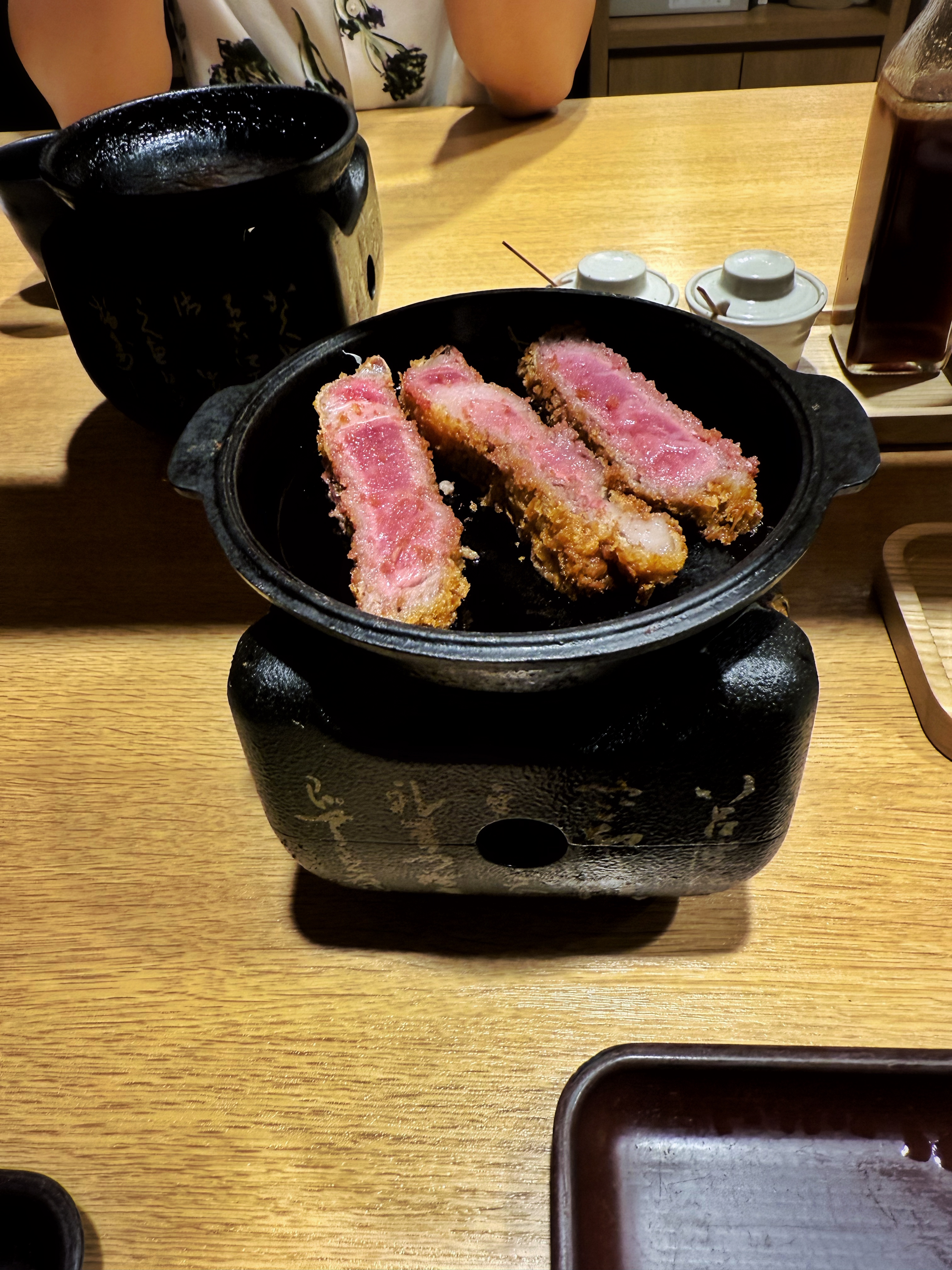
Of course, we spent time exploring the food scene. We had delicious gyukatsu from the chain Gyukatsu Kyoto Katsugyu near Kyoto Station, where we alighted after visiting Arashiyama. Each steak is breaded and fried, and then patrons can further cook each wedge of beef on a tabletop fire to desired doneness.


One of the really nice meals that we came across serendipitously was a wonderful ramen shop called Nandattei near Gion. We were actually on our way to another ramen shop, but as we walked past Nandattei and noticed a queue forming before its opening hours, we quickly joined the queue. Service was quick, and we tucked into rich hot broths of tomato curry ramen. It’s a flavour combination that sounds a bit wild, but the flavours melded beautifully. We smelled of delicious ramen as we left. 


Another ramen joint serving wonderful bowls of ramen was Wajoryomen Sugari. Google Maps will bring you to the right place, even though the shopfront sign didn't spell out the English name. The smell smell emanating from their stock pots (and the subsequent taste) proved that we were in the right place. The broth was made from fish, and each spoonful was deeply flavourful. It was one of the best ramen places that we went to.


We had one of our most memorable meals at a sushi place near Gion that we stumbled upon. Tomi Sushi was in the same area as Nandattei, and we came across it on one of those days when we set off for dinner just a little too late and our shortlisted restaurants were already full. This restaurant’s a small sushi bar with mainly countertop seating. It honestly was quite packed as well, but it had a couple of empty seats. We walked in and found that it caters to a very local crowd (we were the only non-Japanese folks there). There was definitely a bit of hesitation when the staff realised that we didn’t know Japanese, but the staff knew a smattering of English. 


The two of us got through dinner with some ‘osusume onegaishitmasu’ (recommendations please), and a lot of pointing at the menu. The sushi were made to order, the sashimi was as fresh as they come, and the prices were reasonable. I tried a ‘gochisousama deshita’ at the end, but that was harder for me and I’m pretty sure I stumbled over the words. Despite our non-existent Japanese, they were nothing but friendly and outwardly gracious, and everybody - the servers, the sushi chef, and even a fellow elderly customer sitting next to us - did everything they could to engage us in conversation throughout dinner and make us feel welcome. It was a terrific experience.


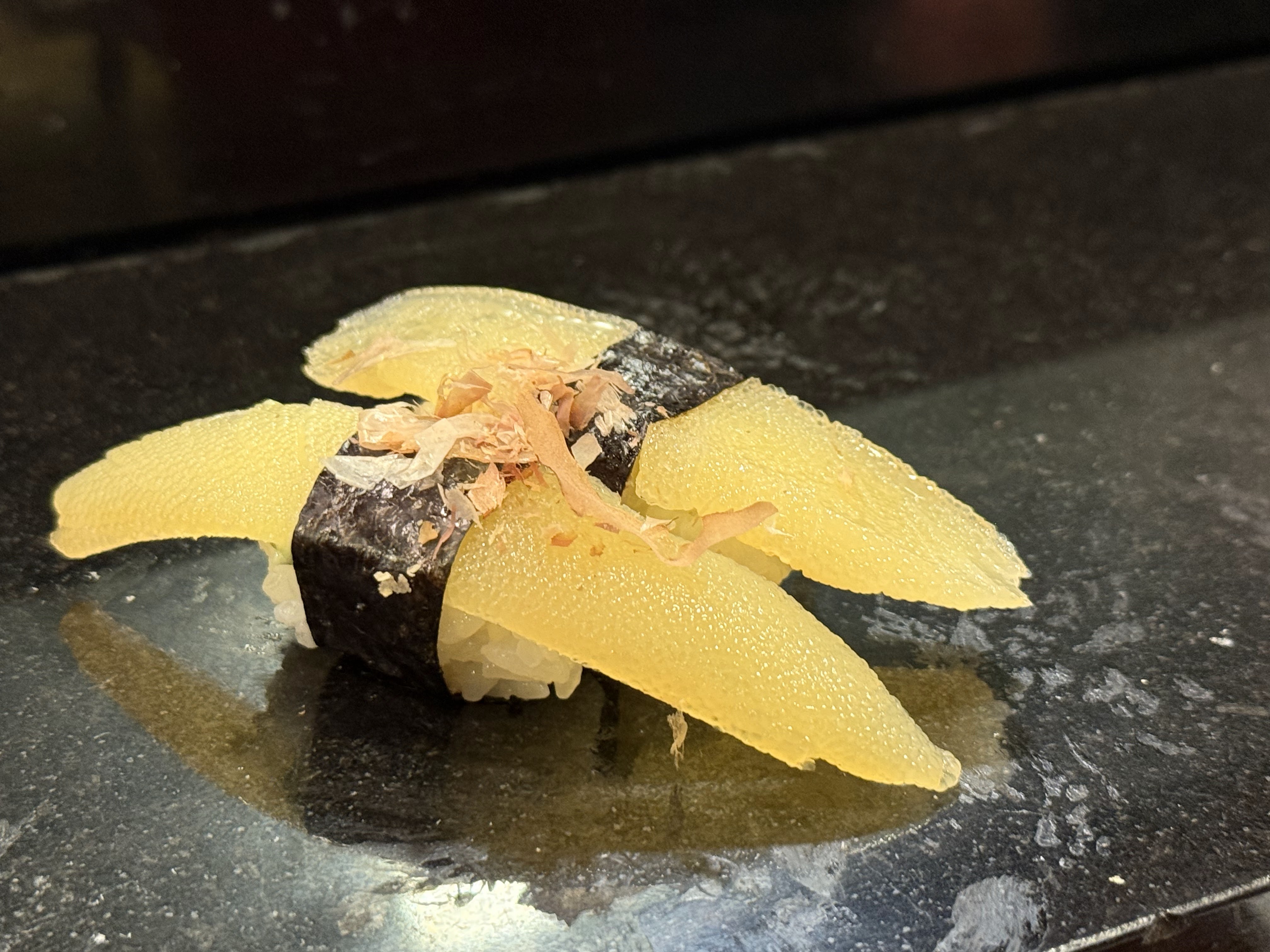
Just take a look at the rice-to-topping ratio!

A recent survey of tourists in Japan indicated that one of their main frustrations was that the Japanese isn’t proficient in English and this had caused the tourists inconvenience. I don’t know what sort of tourists they're surveying, but that’s not how being a tourist usually works. It seemed a bit ludicrous to go to a foreign country, not bother to learn their language and instead expect them to speak yours. The average Japanese’s English is probably far better than the average tourist’s Japanese. The barriers to communications were real, but it was more of a cause for embarrassment for myself for not knowing their language, rather than to feedback that the locals should speak the language of tourists. Did it help with my Tomi Sushi experience that I knew a grand total of 3 short Japanese phrases? I didn’t think that it helped us to get seated, though I certainly felt better about myself for knowing - or at least tried to learn - a few phrases. I probably mangled the pronunciation as well; languages and me don’t mix very well together. But it doesn’t take much effort to at least learn a few phrases beforehand. And the sheer audacity to go to Japan and complain that the locals are not proficient in (insert your native language here)? So silly. But anyway, I digress. 


Fushimi and Uji are doable day trips from Kyoto, and we had fun exploring these areas via a 1 day sightseeing pass for Kyoto courtesy of Klook. This pass covers traveling between Kyoto city, Fushimi and Uji. 

Our first stop was Fushimi Inari Shrine, an immensely attraction for its sheer numbers of Tori gates along the winding path. It was a moderately strenuous climb to the peak, about 1.5-2 hours in total, but there were several rest stops along the way, including two teahouses. It was still insanely crowded even when we tried to come early. Because we were so early that the next attraction wasn't going to be open for the next few hours, we walked to the top. The crowd thinned the further we climbed, and we could get some nice portrait shots from about midway up.

A few train stations away is Fushimi Sake Village, which is located in a quiet lovely neighbourhood. It’s the sake equivalent of a beer hall, and you can order drinks to go along with dishes from several of the food stalls in the restaurant. There are a couple of Japanese in here and a lot of tourists. Everybody had the sake flight in front of them (18 shots from 18 breweries!).


I’ll be a contrarian and say that I’m not a fan of the flight. Most of the sakes on the platter didn’t have much going for them in the taste department, and they weren’t my style of sake. A couple were from breweries that I was interested in, but they were the basic futsushu (table sake) as opposed to the more premium sakes that the breweries were renowned for. All the sakes 
tasted pretty forgettable. The food wasn’t cheap either. I think you’ll have a much better time going to an Izakaya and asking for their recommendations. You might not be able to get 18 shots of sakes for the same price, but each sake would be much more memorable, as would be the food.


We came to Uji after lunch, the matcha mecca. We spent a pleasant hour at the Horhi Shichimeien tea shop. The shop attendants were busy when walked in, but during a lull period as earlier customers left, we were invited to sit at the table where they brewed cups of their 
ceremonial-grade matcha for us. 

It also served as a demonstration for their customers. As the shopkeeper instructed: it’s 2g of matcha in 60ml of water, and to use water heated to 80C. The matcha should be kept in the fridge, and be used within 6 months of opening. 


We were sold on the matcha, but there was a catch: due to severe matcha shortages, the store had a policy that each person could only purchase no more than two bags of ceremonial matcha, and their top grade matcha was limited to one per person. It was disappointing, but in a uniquely-Japanese egalitarian fashion.


As we walked around the town, it struck me was how brightly saturated the greenery was. Was this psychological? It certainly didn’t seem as green in other countries, or even in other cities.


While in Uji, we visited the Byodo-in Temple, a Buddhist temple designated as a UNESCO World Heritage Site. Its likeness is stamped on the back on every 10 yen coin. The ticket office staff kindly broke down one of my larger notes so I could hold up a 10 yen coin in front of the temple.


Like some of the larger major temples, 
Byodo-in Temple has a Goshuin station, where you can mark a page of your Goshiun notebook with its calligraphy and an official stamp of the temple.  

Afterwards, we had a pleasant time sitting at Nakamura Tokichi Byodo-in for matcha drinks and parfaits next to the river.

There's plenty to see and do in Kyoto, but the advice I got was to take it easy and enjoy each moment instead of ticking every temple off a checklist. We spent 5 lovely days in Kyoto, and had a terrific stay in Sora Niwa Hotel. It’s near Gion, close to all the delicious restaurants, and even better, there are pre-dinner cocktail drinks on the rooftop and a full traditional onsen experience. It was simply the perfect Kyoto experience that we were looking for (yes. Even for someone like me who came in expecting a 1900s-era Kyoto.) 


Recent Japan Travels:

Osaka in Spring 2025: Osaka City (Part 1)

Osaka in Spring 2025: Kyoto and Uji (Part 2)

Osaka in Spring 2025: Hida-Takayama and Shirakawa-Go (Part 3)

Osaka in Spring 2025: Toyama and the Alpine Trail (Part 4)

Osaka in Spring 2025: Matsumoto, Nagano: (Part 5)

15 June 2025

Osaka City: Osaka in Spring (Part 1)

June 15, 2025 0
Osaka City: Osaka in Spring (Part 1)

We landed in Osaka half an hour earlier than scheduled (planes can do that? Go Scoot!). We had booked our airport transfer railway tickets for a later timing, but it was no biggie to reschedule our railway tickets for an earlier timing on our phones. I didn’t know about this tidbit when we came to Osaka, but apparently, in the last thirty years, Kansai Airport has not misplaced a single luggage. And that’s not all that is amazing here. After we passed customs and reached the Baggage Collection area, we saw that the checked-in luggage had been taken off the conveyor belt and placed in neat rows by the side for the owners to wheel away (!) I was pretty gobsmacked. Not only do passengers not have to wait for their luggage, the luggage have also all been taken off the belt for us? In no time at all, we were out of the airport and on our way. 


We were staying in Shinsekai for a night, and the first order of the day was to find food. A queue was already forming by 5pm in front of Kushikatsu Daruma, and so we quickly joined it. This small shop is the originator of Kushikatsu, the regional specialty of deep fried skewers. It’s a small restaurant, with about 10 countertop seats available. The customers were fully locals, but there was an English menu, and armed with the phrase “o-susume onegaishimasu” (recommendations please), the restaurant staff and I made the dining situation work. I might have used it a bit too liberally though: at one point, he asked me if I wanted a beer, and while in front of the fridge overlooking the bottles of Asahi beer, I still replied with “o-susume onegaishimasu”. I think he laughed at me.


We started off with doteyaki, a traditional Osakan specialty of beef tendon stew with chewy rice cake cubes.


It was an excellent restaurant: he pointed to each skewer as he served them, and explained which was which. The skewers were wonderfully battered and fried with a very clean taste, there was no excessive oily texture or taste. From meat to vegetables to juicy mushrooms, there were no faults. After a fellow customer bit into his skewer and pulled away with a thick stretch of cheese between his skewer and his mouth, we quickly ordered what he had. The deep fried Camembert and mozzarella skewers were outstanding.


There were plenty of street food in Shinsekai, and we walked around the area and soaked up its iconic retro vibe. I bought the local favourite Okonomiyaki, a filling savory pancake dish cooked on a griddle. This Okonomiyaki from a busy corner store turned out to be a really really good version out of out of all those we’ve had.


it didn’t look the best, though. Perhaps it wasn’t meant to be carried sideways? Also, Strong Zero isn't half of what reddit raved about. It’s a one-dimensional cheap lemonade fortified with booze. There are much better drinks out there.


We left Osaka for a bit to tour Kyoto and the surrounding Alpine towns (more on that in a bit!), but we returned to Osaka for the last leg of our holiday. We were planning to explore the cultural side of Osaka, but life in a busy city has a way of filling up our days. There are markets to explore, restaurants to eat and shopping to be done.


Everyone visiting Japan should try Cremia Ice Cream at least once (can be found in many different restaurants.) The cone is a thin rich crisp made from langue de chat, and it tastes like an ice cream version of Shiroi Koibito


Strawberries are still in season, and we finally tried some of the fancier white Japanese strawberries. We ate strawberries for breakfast almost every day . 


While not strictly a tourist attraction, I spent a lot of time salivating over the kitchenware at Sennichimae Doguyasuji Shopping Street. Who doesn’t need more cookware in their lives? We bought chopsticks, alongside a bamboo matcha scoop and glazed matcha bowls. I picked up a pair of kitchen shears from Tojiro, and then spent another hour sighing over their knives. I also tried to find a Kamado-san, or Japanese clay pots, which I’ve heard are quite reasonably priced in Japan and outrageously expensive elsewhere. In the end though, I passed on it because my luggage were already full with sake bottles. Maybe next trip.

Our days in Osaka passed pleasantly. There’s no shortages of things in Osaka to sing praises of (for example wet serviette that came with every meal, even from 7-11), but the most memorable aspect was the bar scene. The bespoke bars blew me away with their cocktails.


Our first bespoke bar experience was at
Whisky&Cocktail BAR SIMON 大阪道頓堀, which was hidden behind an unassuming plain wooden door on the second floor of a small building. It’s a small bar, fitting no more than 10 patrons. The place was empty as we walked in after an early 5pm dinner, but it filled up by 8pm. The crowd was well-deserved. 


Bespoke bars have no menu. You instead tell the bartender what you like and he’ll make a drink that fits. The four of us told him what we were each looking for, and we watched him build four drinks concurrently to serve us at the same time. Near the end, he returned with several chunks of ice and proceeded to hand carve each ice into different shapes to fit each drinking vessel.


He tasted each drink as he made it, which was a step that I’d not seen before. My first drink (I asked for something fruity and floral) was good. My second (to make a cocktail with Kinamori Gin, a Japanese gin that I had been trying to find a bottle of to no avail so far) was on point: the gin shone in a sweet cocktail with chartreuse that highlighted the gin’s woody notes.


Because there was no menu, we didn’t know how much the drinks cost. But as we were sipping on our first, then second, drinks, I found that I didn’t much care about the cost, I just want to see what else he’s got.


A request for a “cocktail that tastes like tea” gave him pause. He took the bottle of chartreuse that he used for my Kinamori cocktail, sniffed at it, frowned, sat it back down and reached for another chartreuse. (We learnt later that the second bottle, a limited edition bottle, had a different flavour profile). There was Ki No Bi gin, chartreuse, coconut water and green tea liqueur. The end result was a deliciously clear green-coloured cocktail, and tea-forward as promised.

I enjoy baking and cooking, but even as finicky as baking can be, at least all the ingredients are pretty much interchangeable from brand to brand. Can you imagine trying to bake if one AP flour tastes dramatically different from another brand of AP flour? Crafting cocktails off-the-cuff just like this is simply on another tier of skill. As we each finished our second drinks and as the small room gradually filled up with customers who started smoking, we settled our bill: the drinks cost about 1700 yen on average, and there’s no cover charge. Incredible.


Another bespoke bar is Bar Nayuta. I’m spoiled by this no-menu customs, because my pet peeve is trying to read a menu in a dark environment. Non-smokers would be happy to know that Bar Nayuta is strictly non-smoking, which is pretty rare amongst the bars here (We visited Bar Shiki and Bible Club a couple of days ago, and our experiences at both of the bars were spoilt by a single smoking customer. Cigarettes are period-accurate for The Bible Club’s atmosphere yes, but all that second-hand smoke isn’t enjoyable.)


We put in our usual requests: a tea-forward cocktail, a floral sakura one and a woodsy cocktail. They were all good. The magic came at our fourth request, when we asked for a cocktail “that tastes like popcorn”. (The context was that the Bible Club’s menu had a popcorn cocktail made with popcorn-flavoured vodka which my wife liked. We wanted to see what Bar Nayuta could do with this curveball order.) The barhelp commented that it was a hard order with a rueful smile, and after clarifying that we didn’t mean something with a yuzu corn profile (I don’t know what that is, but now I’m interested), passed the order to a first bartender. We could see him mouth POP-CORN? from across the bar. The order was then handed over to the head bartender. A few minutes later, we thought could smell caramel popcorn from the countertop, though from what possible ingredients, I could not tell for my life. He definitely wasn’t melting sugar for one. To the caramel-like concoction in the cocktail shaker, he added shochu, egg yolk and cream. As a finishing touch, he sprinkled sugar and used the blow torch for what looked like ages to get a crème-brûlée-like topping over the drink. It’s not a large bar, and the seats were facing the bartenders. All conversation at the bar stopped as everybody turned to watch him handle the order.


The drink wasn’t just a spectacle. It was spectacular. What came out on the other end was truly amazing, and surpassed anything I could have dreamt of. The drink itself was thick, creamy and sweet,  like an eggnog with tones of caramel. The edge of the glassware was rimmed with salty and hence tasted both sweet and salty, just like a sweet and salty popcorn mix. 


We loved the bar culture so much, we went to 1-2 different bars every night, usually with dinner before and supper afterwards. I thought that the restaurants in Dotonbori and Shinsekai (the main tourist districts) would open til late and would be perfect for bar crawls, but as it turned out, most shops are shuttered by 9. (What’s up with this? Osaka is a metropolis and Dotonbori in particular is meant to be The Place for Nightlife). but luckily we found a few places that are opened til late for supper.


We had a good supper in Shinsekai Kushikasu Ittoku Hozenji, a kushikage in Dotonbori open til midnight. The skewers are freshly fried, and a perfect follow up to cocktails. 


Mambou (Mambo on Google Map) makes good okonomiyaki, they’re run by a cute elderly couple and their son, and also, they are open until 1am. 


Ten Ti Jin has a few branches around Osaka, They’re open until 3am. The service can be a little gruff, but the charcoal-grilled pork bowl (butadon) is a work of art. 


Aside from my gripe about how early restaurants close, there are many good restaurants all over Osaka, and available at every price point. Rather than trying to tick particular restaurants off a checklist, we’ve learnt instead to choose our restaurants by their locations and their opening hours. There were also lunchtime specials from many restaurants.


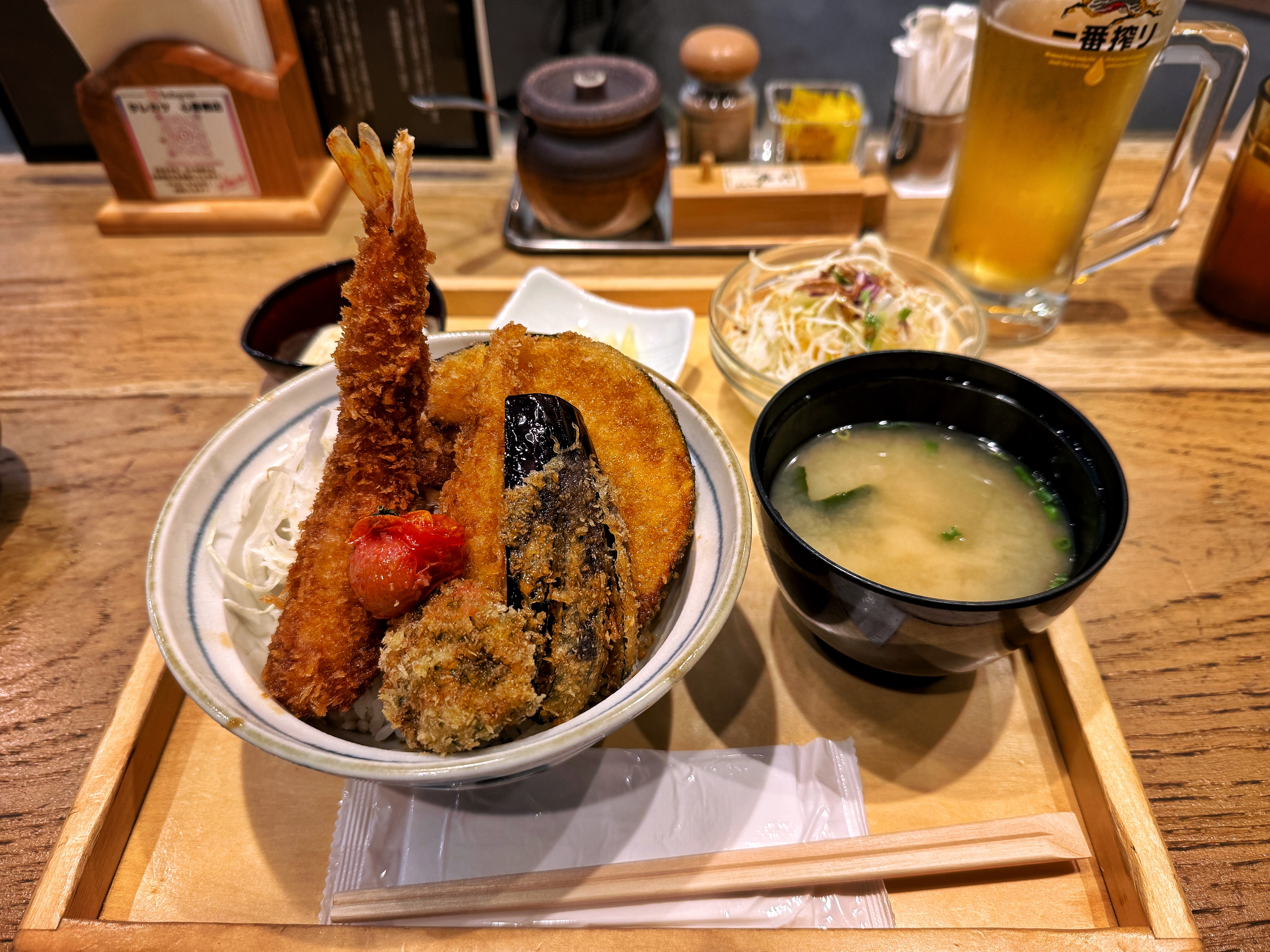
We had the lunch set at Tempura Daikichi Namba Komejirushi near our hotel, which goes for 900 yen per pax. You get a full meal of rice, a set of tempura, and clam soup. We’re particularly fond of Set D (The Lady Set), which comes with tempura fish roe, and a skewer of fried cheese and cherry tomato.


One of the ?perks of the restaurant is that customers get to throw clam shells from  the soup onto the floor. The floor is full of broken clam shells, and you can add yours to the pile, if you like. Though I think woe betides you if your clam shells fall into another table's bag basket (which is also on the floor). 


Gokai Tachizushi Nambanankaidori, for example, is a sushi place with pretty good service. They also seem quite flexible as to what constitutes lunchtime. We visited close to 5pm but still somehow qualified for their lunch offer. Our bowl of rice came with a mountain of uni and roe (it’s as generously filled as it was pictured), with a side of those firefly squid from Toyama.


And look at the size of each unagi sushi!


Niigata Katsudon Tarekatsu Shinsaibashiten was another good find with a lunch promotion. The pork fillet is pounded into thinly before being breaded and deep fried, and the rest of the tempura were all well fried. I think I ate more fried food on this trip than the entirety of last year.

Chibo Okonomiyaki is a curious restaurant. It’s run like an Emergency Department and I was getting flashbacks. The cooks are constantly cooking several okonomiyaki in front of them. When their shift is up, they just hand-over to the next person coming on for the next shift to continue the cook. There’s a hierarchy in the staffing, and there was clear deference being shown from some cooks to other cooks. The service was great, and there’s a good deal of showmanship, but there are better okonomiyaki around. 


One surprise for Osaka: it’s called the food capital of Japan, but I think a more accurate term would be the street food capital of Japan. There's loads of restaurants serving okonomiyaki and takoyaki clustered in Dotonbori, but so many of the popular restaurants all also serve these street-style food. I have a few quibbles with the Osaka branding. Still, Osaka's a nice place and I'll happily spend a few days there anytime. 

Just make sure you have your dinners early.


Note the deserted streets and shuttered storefront in Shinsekai. The sun's not even set yet!  

Recent Japan Travels:

Osaka in Spring 2025: Osaka City (Part 1)

Osaka in Spring 2025Kyoto and Uji (Part 2)

Osaka in Spring 2025Hida-Takayama and Shirakawa-Go (Part 3)

Osaka in Spring 2025Toyama and the Alpine Trail (Part 4)

Osaka in Spring 2025: Matsumoto, Nagano: (Part 5)