Chik's Crib

04 June 2018

Earl Grey Ice Cream Recipe

June 04, 2018 1
Earl Grey Ice Cream Recipe
I went through a few Earl Grey ice cream recipes online trying to find one that I liked. The first version was from Van Leeuwen Artisan Ice Cream, which uses a traditional French custard style of ice cream using egg yolks. I probably left it on the stove for a bit too long, which cooked the yolks. It was still salvageable, but I wasn't impressed with the consistency. 

I'd heard remarkable things about the consistency of the Philadelphia style, and was keen to give it a go. The Philadelphia style is made without egg yolks, and Jeni Bauer's ice cream cookbook were making traction online for their sensational flavors and smooth consistency. She has a base recipe which lends itself easily to any flavour that you can think of. Lindsay from Scoop Adventures did an Earl Grey variation, and boy, did I hit the jackpot. It was everything I want from in my ice cream; a deep, bold earl grey profile that highlighted the smooth consistency of the dessert. Bonus!: Because of the no-egg rule, the recipe has quite a bit of leeway when cooking and there's no fear of leaving the mixture over a fire for a bit longer than you should have. 


Earl Grey Ice Cream
Adapted from Lindsay from Scoop Adventures. Original base recipe by Jeni Britton Bauer
Makes 1L 
I use Twinning's tea bags for this recipe. When cut open, 8 tea bags yield 15g of loose tea leaves. They were easily strained away afterwards with a nylon sieve, but I'm thinking for future recipes, I can leave them in the tea bags for convenience. Loose tea leaves in the photos are from French Earl Grey from Higher Living


INGREDIENTS
30ml + 470ml (500ml/2 cups) whole milk
315 ml (1 1/3 cups) heavy cream
100g sugar
30 ml (2 tablespoon) corn syrup 
8 tea bags (15 g) earl grey tea leaves
11 g (1 tablespoon + 1 teaspoon) cornstarch
45 g (3 tablespoon/1.5 oz) cream cheese, softened
1/8 teaspoon kosher salt


STEPS
1. In a large saucepan, combine 470ml of milk with the heavy cream, sugar and corn syrup. Place over medium fire, stirring constantly until sugar dissolves.  

2. Add tea leaves and mix. Stir over the fire until mixture starts to simmer. Turn off the flame and allow leaves to steep for one hour at room temperature. 


3. In a small bowl, mix 30ml of milk with cornstarch and return to fridge. Remove cream cheese from fridge and into a large bowl. Let it come to room temperature, and whisk until smooth. Set a fine mesh sieve over the bowl and set aside.


4. When the 1 hour is up, discard the tea bags. (If using loose tea leaves, sieve the tea leaves out, and press firmly on the leaves to extract as much of the tea-infused milk as possible. Discard the tea leaves.)


5. Place the milk mixture back over a small fire and bring a boil for about 4 minutes. Remove from heat and whisk the cornstarch mixture in. Return to a boil cook over moderate heat until the mixture is thickens slightly, about 1 minute. Remove from heat. Pour the hot milk mixture through the sieve into the large bowl containing the cream cheese. Whisk until smooth. Add salt.


6. Let the mixture cool completely (an ice water bath helps) before covering bowl and place in refrigerator to chill overnight, or at least 4 hours. Pour into an ice cream maker according to the manufacturer’s instructions. 

28 May 2018

The Zen of Baking: Erin McDowell's Flourless Cocoa Cookies

May 28, 2018 0
The Zen of Baking: Erin McDowell's Flourless Cocoa Cookies

After a six-month hiatus on baking, I thought I could kick off my cooking gears with a no-frills, low-stress easy cookie recipe. Who doesn't love cookies? It's easy to put the ingredients together, and in a recipe like this, the steps are immensely forgiving, and you can miss a few steps here and there without being too worse for the wear. 


That optimism was stretched when my house suffered from an outbreak of equipment malfunction. Something must be contagious, and it's not just my enthusiasm! Both my electronic weighing scales and my oven went on the frizz. 


But Calvin, you ask, when did you discover the malfunctions? Great question, and your inquisitive nature is laudable. The most Zen moment to discover a non-functioning oven would naturally, be when the batter is done


It hadn't been easy, but I've learnt to roll with the punches. I packed the cookie scoops into the fridge until after I located an oven. The recipe said to bake straight after mixing, but surely there's no harm in sticking them in the fridge for a few hours, or even overnight's quite fine too, as it turned out, and now they sit very magnificently in front of you, leaving your hearts thumping, marvel blossoming in your chestseyes wide and jaws agape, wondering how did he bake these? And is he single? 

Baci di Dama cookies - bottom left
I'll tell you how I baked them. Like most things in life, the making of a cookie may lead you on unexpected detours. Sometimes, it involves the hunting for spare batteries in the house before giving up and trying to locate a third weighing scale in the house. It could involve driving out at 8pm on a weekday night trying to buy an oven, while trays of cookie batter warm up in your car boot. It may require angling for a discount for an oven while avoiding thoughts about said cookie batter melting into puddles in your car. 

Sometimes all three. 

But no matter. The best cookies are not made by slapping ingredients together in a mad dash. Like all art, the process can't be rushed. It's made with fortitude in the face of kitchen adversity (in your face, mis en place!), carefully sifting the flour, mixing the chocolate in, shaping the dough, maybe leaving work a little early the next day to install an oven. 


It's an exercise in Zen, the baking of cookies. 

                                          ========================

Flourless Cocoa Cookies  

Original recipe by Erin Jeanne McDowell from The Fearless Baker', published in The New York Times

23 May 2018

New Ubin Seafood

May 23, 2018 0
New Ubin Seafood
I'm always in the mood to hear about zi char stores that have been making a splash in food circles. On one end of the spectrum is the traditional kind of zi char stalls like Por Kee, an established presence serving up orthodox zi char - think plates of perfectly-done beef hor fun and braised tofu. On the other end is the team at New Ubin Seafood, bringing fresh ideas into the mix and pushing the boundaries of what zi char can be. 


We kicked off the meal with Brinjal Delight, deep-fried, crisp brinjal slices drizzled with a sweet sauce. The undertone of lemongrass complements the sweetness of the dish, and it's an impressive way to start a meal. Much like how 唐人轩 in Guangzhou has their magnificent brinjal dish, I'm glad I've found a local equivalent here. 


The rich sauce accompanying the Hokkein Mee Special dialed up the seafood flavor of the dish up to an 11. The heaviness of the dish didn't sit overly well with me in every mouthful of noodles, but was decadent with the giant prawns


I enjoyed the spin on the traditional kailan, served with crunchy slivers of fried seaweed on the side. 


They know there's only one way to cook a steak - medium-rare, and our US Rib Eye Beef was perfectly seared with smoky, crisp charcoal-tinged edge and a pink, juicy interior. I snapped up most of the rarer cubes while being given the dubious eye by my mom, who reached for the well-done edges. To each their own. One beef I had with the dish (get it? Ha ha) is the heavy-handedness with the salt. This is a dish that demands to be shared; your taste bud will rebel if you try eating one by yourself.  


The complimentary Beef Fried Rice was soggy and clumpy, and drowning the rice in salt and dark soy sauce did the dish no favour. Am I a grinch for not enjoying this picturesque dish? The sticker shock is real (this dish costs $84), and the quality of the cut or the marination is not in the same league as other restaurants for the same price point. 


What we did enjoy were the crabs: the fragrant Garlic Baked Crab, and the Chili Crab. The fragrance of the garlic crab approached the table before the dish, and even the whole roasted garlic cloves are delicious when peeled and eaten. The mantou is perfectly deep-fried; hot and crisp on the outside, and perfect with the chili crab sauce. But fair warning, the chili is intensely spicy. 


New Ubin Seafood 

63 Hillview Avenue, Level 6 (Canteen), 669569


18 May 2018

Honest Grill @ Grains&Hops - Cheap Grilled BBQ and Cheaper Beers!

May 18, 2018 0
Honest Grill @ Grains&Hops - Cheap Grilled BBQ and Cheaper Beers!

In a quiet corner of Pandan Loop's industrial estate lies Honest Grill, a homely establishment that carved out a place for itself amongst the locals. It's located in an area with seemingly zero foot traffic, but the affordable food and alcohol makes it a local hot spot for supper.


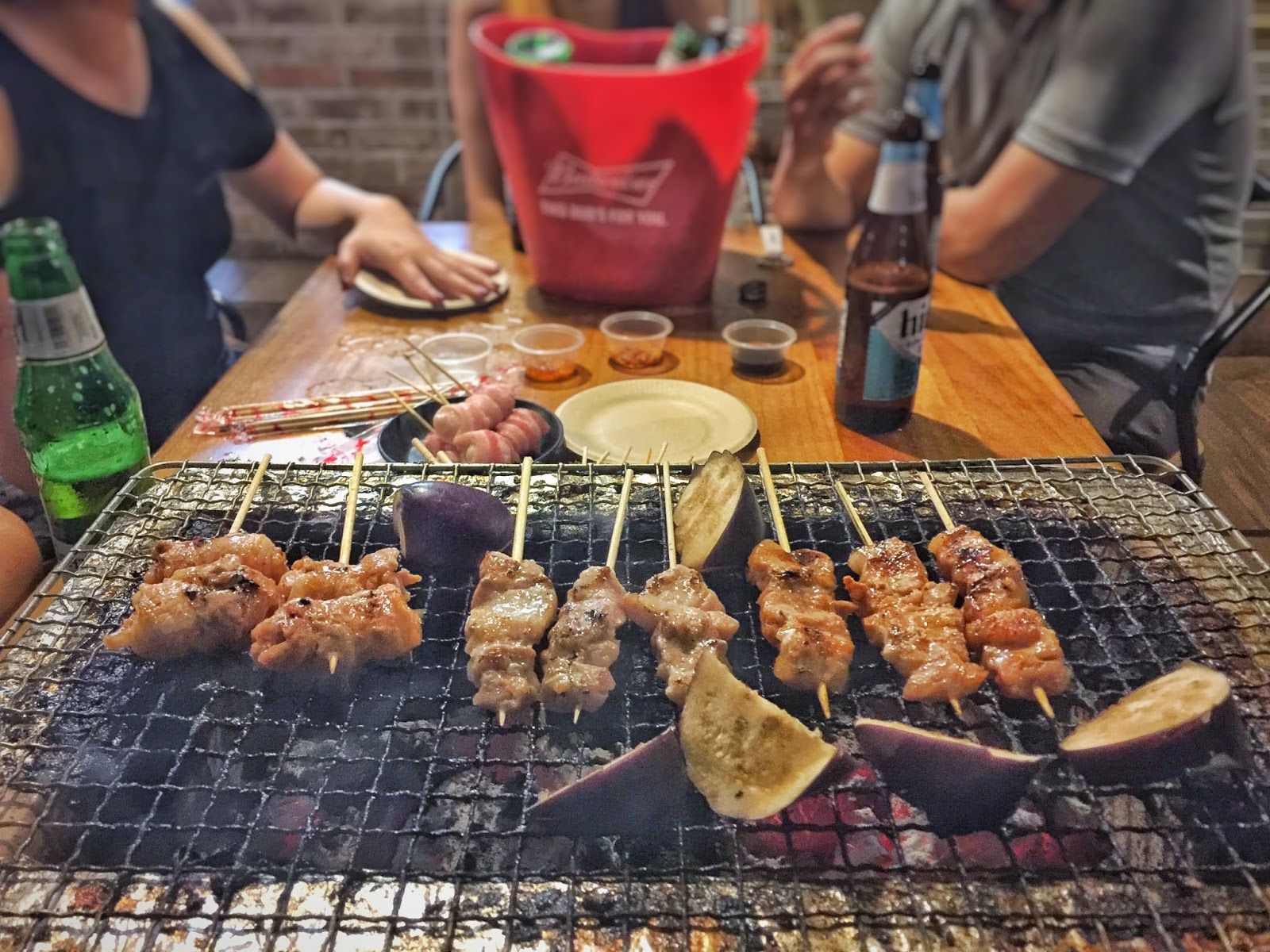
The joint lights the area up like a candle in the dark - the industrial park is hushed in the still of the night, but the bustle of Honest Grill drew us in from the adjourning streets. Customers sit merrily over a small charcoal set-up, grilling up a melange of meat and vegetables. Most people congregate near the back of the store, where it's closest to the stall selling the raw cuts of meat, but we elected for the quieter, breezier side along the storefront. 


The bacon-wrapped quail eggs could've used a little trimming of the fats, though we were big fans of the DIY-grilled oysters and brinjal slices. The best-seller was the 50c-a-stick pork belly, and we ordered as many as we could finish. 


Still, this place is a watering hole first and a grilled meat joint second; the main draw is the $30/10 bottle deal, and over our supper, some customers just dropped by to pick up beers. I'm not a big beer drinker, but it's nice to kick back and relax with a pint or two before the weekend officially starts.  


Honest Grill @ Grains&Hops

198 Pandan Loop, Singapore 128386
5.30pm - 10.30pm, Closed Sundays

29 April 2018

A Week in Guangzhou Part 5 - Tips for Traveling in Guangzhou

April 29, 2018 0
A Week in Guangzhou Part 5 - Tips for Traveling in Guangzhou

Guangzhou is one of the safest cities I've been to. We walk the streets at night in a loose group, usually around the Beijing Pedestrian Street area (北京路), and never once feared for our safety. There isn't bands of pickpockets roving around the metro stations like in Rome, and Guangzhou's tourist attractions are free of scammers common in other cities. 


That said, it doesn't hurt to be wary of non-violent crimes. Standard precautions apply while traveling by public transport - sling your bags to your front to avoid presenting yourself as an easy picking for pickpockets, and avoid using your phone if you're standing near the metro doors in the train (people may reach into the train and snatch your phone just as the door closes.) I seen nothing to warrant such precautions, but still, it's what the locals do, and it's better to be safe than sorry. 


One feature of the city is how much they seem to value safety: at metro stations, bags have to be fed through X-ray machines a la airports, and commuters have to clear metal detectors before getting past the gantry. If you're as easily confused at directions like I am (with subpar Chinese reading skills to match!), be prepared to re-enter each gantry several times looking for the right way out.    


Getting Around

Traffic laws in Guangzhou are friendly towards cyclists, and it's one of the reasons why bike-sharing programs like Ofo and Mobike are able to take off rapidly in China. One of the more curious traffic laws in Guangzhou regarding bikes had me stumped: traffic lights do not apply to bicycles. It's always a little of a shock to the unsuspecting pedestrian (read: me) when the Green Man flashes and I thought it's safe to cross an intersection, only to get bikes whizzing out at me as I step off the curb.   

Otherwise, walking in the streets of Guangzhou is similar to most other Asian countries. People are used to being in close proximity with one another and small jostles on the streets are common. An apology, though nice, is not necessary or even expected in Guangzhou. (Which, now that I think about it, may not be all that different from certain European countries...So don't be offended if someone barges right into you, and then pretended it never happened. I've walked into a few people too, and they simply shrugged it off and continued on their way without making eye contact. 


Dining 


大众点评 (da zhong dian ping) is what the locals use to rate restaurants, but you're mostly plain out of luck if you can't read Chinese. Local recommendations rarely filter over to the English-speaking section of the internet, and most of the restaurants that enjoyed tourist fame in English-speaking websites are not as well regarded by locals. It's really a shame to come to Guangzhou and miss out on the excellent Cantonese cuisine! I've listed some of the restaurants that my relatives recommended in my previous posts, and while their recommendations seem strangely congregated near 北京路 Beijing Lu (their area of residence), I haven't had such superb Chinese food before, or since my visit. In my future travels to Guangzhou, I'm looking forward to exploring meal options in other districts, but the restaurants that they recommended are definitely worth a revisit (or several!). 


Dining etiquette in Guangzhou can be a little different from the rest of the world. I remember on my first visit, my relatives were utterly bemused when we loaded food onto our plates to eat. In most traditional restaurants in Guangzhou, the plates are considered unclean, and plates are solely relegated to holding discarded food waste. 


Rule 101 of the Guangzhou Dining Etiquette Handbook (TM): the utensils that haven't been washed with tea are not clean enough to come into contact with food. In dim sum restaurants, the teapots come out alongside basins, the latter is where you dump out tea that had been used to wash utensils. First, set your chopsticks into your tea cup, and then pour tea over the chopsticks into the tea cup to 'rinse' the chopsticks. Second, remove your newly-cleansed chopsticks and dip your soup spoon into the tea. Third, pour the tea into the bowl, and, holding your tea cup horizontally, submerge it into the bowl. Give it a good 360-rotation in the tea, to clean the part of the cup that comes in contact with your mouth. Discard the tea into the giant basin; your bowl, chopsticks and soup spoon are now good to go! It's also considered polite to move around the table washing other sets of utensils, though those more fastidious about cleanliness may choose to do it themselves...


Notice how the plate doesn't get a wash with tea? Hence, no touchy touchy with food. I made the faux pas of putting someone's newly-cleaned soup spoon on her plate at the start of dinner, and I don't think she used her spoon at all throughout the dinner. 


Germaphobic-culture aside (this ritual honestly 
could be just my family), dining in Guangzhou is a visceral pleasure. I even got to experience the joy of Chinese customs of walking around the table toasting individuals with shots of bai jiu, with the aim to get someone else more drunk than yourself. The potent shots of moutai get the job done fast, and it's always fun to try and negotiate toasts coming your way (or when failing to not take the shot, to rope others in so they have to down a shot with you too.) It's fun, so don't miss out on the drinking! After I experienced the fun of walking around the room coercing encouraging relatives to drink shots with me, it's hard to go back to the old Singaporean way of dining, where everybody sits and picks over the food. A quick note - we often use 'gan bei' synonymously with 'cheers', but in Mainland China, it literally means '[a] dry cup' - to literally drain your cup dry. If all you want is a clink of the glass and a quick sip of liquor, say 'cheers' instead. 


As with drinking, clamouring over the bill is another game which everyone is expected to partake. It's a social nicety, much like the equivalent of a grocery store cashier in Melbourne asking how your day was. Not making an attempt to pay is the equivalent of staring blankly at the cashier. Cheeky acts, like sneaking off to the cashier under the guise of going to the restroom mid-dinner, or hoarding the bill under your utensils to make sure no one else can pay, is commonplace. My relatives pulled off some impressive vanishing feats during dinner, and I was none the wiser until I too sneaked off to the cashier, only to be told the bill had just been settled. (Less successful vanishing acts typically end with the person being escorted back to his seat by a crowd of table-mates, all of whom are pleased they caught someone else in the act, and are most probably eyeing the bill so they too can sneak off later with it.)


Table manners are simultaneously more relaxed and stricter. Spitting bones out onto your plate with merry abandonment? Pfff. No one's going to bat an eye. But for every new dish that arrives at the table, no one touches the food until until the guests sampled the dish first.

If you're like me, a dinner like this may fill you with joy, anticipation and a wee bit of stress. But mostly joy. Enjoying a meal with my relatives - what with my crap Cantonese and all - is some of the most fun-packed dinners I had. 

                                                    *********************


China's pace of  development is impressive, if not a little scary. Six years ago, we gingerly watched our every step, for fear of stepping onto spit on the sidewalks. Restrooms in restaurants were universally filled with cigarette smoke as smokers smoked away wantonly between dishes. Barely six years later, it's a wonder to see how much the city has cleaned up


Before heading off to China, we downloaded a few apps onto our phones to make life easier. The user interfaces are in Chinese, which I'm honestly not all that literate in, but still,  I used those apps on a daily basis. WeChat is essential to keeping in contact with one another. Whatsapp is blocked, as are Facebook Messenger, Instagram Message and Snapchat. We got by for a bit using iMessage and FaceTime between iPhone users, but you're plain out of luck if someone is a non-iOS user. It's even worse if you're an Android user - Google is blocked in China, and this means Android users can't access their Google Play to download these apps once they reach China, so do download everything you need to before you depart! (As an aside, that means that my blog, running on Google, is blocked in China too... sigh).

Google Maps doesn't work either, and you'll have to use 百度地图 (baidu maps). 大众点评 (da zhong dian ping) is the local Zomato equivalent for restaurants, and is useful to have on hand when searching for nearby dining options. Another app that was recommended was 蚂蜂窝自由行, which I didn't use, but was described as the local Tripadvisor.  


Our cousin-aunt bought us an affordable phone plan aimed at locals - a RMB100 plan that provides 800MB/yuan. Otherwise, data is pretty expensive for foreigners; the cheapest I've seen was RMB200 for 9GB of data. It may actually be cheaper to buy roaming data from your existing phone provider - it's what a friend did, and miraculously, using one of Singapore's phone provider's network, he could still access Facebook and Whatsapp. Hmmm....


                                                    *********************

A big thank you goes out to my relatives in Guangzhou, without whom this itinerary would otherwise not be possible.